 |
|---|
By Joanna Klonsky
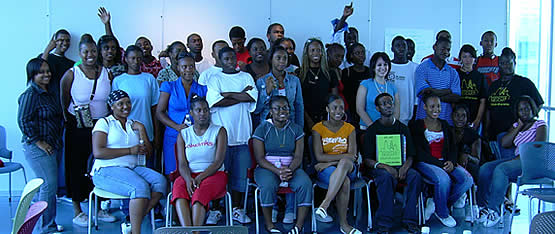
CHICAGO, IL—The sight of 25 students enthusiastically arriving at school on a summer weekday is a strange one. The group that gathered each day in a Spanish classroom at Chicago’s North Lawndale College Prep is not here for summer school. The Umoja Student Development Corporation’s summer Community Builders program employs these teens for six weeks to develop action-based research projects on social issues facing their neighborhood. “Every summer, we explore a critical issue in the community,” says Anna Osterbur, a Student Advocate Fellow for Umoja.
Umoja, which was founded in Chicago’s Manley Career Academy High School in 1997, was intended to connect the school to the surrounding community. “We’re not a youth organizing organization,” says Osterbur, “But we do have a very action oriented approach. We want to develop students who are actively engaged in their communities.”
In light of this goal, Umoja’s summer program, Community Builders, has run projects on topics ranging from an oral history of the North Lawndale neighborhood to gentrification to school reform, among others. This summer, the subject of the program is “Advocates of Peace: Working to Reduce and Prevent Violence and Conflict.” The focus is “figuring out ways to increase peace in our community,” says Community Builders participant Shaquita Johnson, a junior at Manley. “We’re broken down into four different groups, and each group researches a theme that they feel has grown within our community that needs to be controlled.” Those themes this year include the relation between violence and the prison system, child development, education, and the media.
Becoming experts in the field
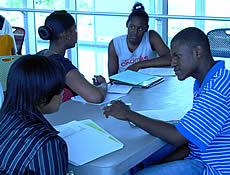 During three days of each week at Community Builders, the students take part in an inquiry on their team’s topic. They take field trips, hear guest speakers, listen to podcasts and watch films, all “to become experts in the field and getting our heads around as many different angles of it as we can,” says Osterbur.
The students started by conducting surveys about the security and level of violence in their own schools. Then, says Osterbur, “we kind of expanded that to thinking about not just violence in schools, but in the community, and then in terms of bringing it home and thinking about it on a personal level.”
Through their research, the students come to understand the underlying issues involved in their focus topics. “I didn’t know they put more money into jails than they did into schools,” says Manley senior Timothy Sewell, 17, a member of the group focusing on prisons and incarceration. “There was a lot of stuff I was unaware of.”
“Project day”
The fourth day of each week is “project day,” in which the students work on the production of a CD and a documentary. With Free Spirit Media and the Crib Collective, the students learn how to use video cameras and film interviews around the community to produce a 10-minute piece.
The CD contains spoken word pieces and music relating to the issues the youth have spent their time exploring during the rest of the week. The process of creating that CD “really intrigued me to be a part of this,” says Sewell. “Being a poet, I wanted to get involved.”
A focus on the future
A fifth day of each Community Builders week is devoted to college and career planning for the participants, who are primarily low income African American teens. They do mock college interviews, discuss the ACT and SAT, and learn to decipher college vocabulary like FAFSA, financial aid, scholarships, and loans.
For some of these students, this focus on college can be life-changing. “I wasn’t even thinking about going to college,” says Sewell, who went on a college tour last school year with Umoja to several southern colleges. “I never really thought about going outside of Chicago.” The Umoja poetry team, of which Sewell is a member, held a fundraiser to help pay for the trip. “It was my first experience on a plane and my first experience down south,” says Sewell.
“Safe zone”
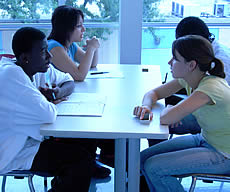 In addition to developing research and leadership skills, the Community Builders participants tend to forge close bonds with one another. “It’s a safe zone,” says Jessica Madison, 15, who calls the environment in Community Builders “family-based.” As such, many of the teens begin to open up to the group about their own personal experiences with their research topic.
Working closely together and spending so much time as a group “is ground for really profound, really deep team building and insight,” says Osterbur. “They become really comfortable with each other.”
Toward the summers’ end, the Community Builders put on a showcase for their community in which they exhibit the findings of their research projects, perform the pieces on the CD they produced, and screen the documentary. When school starts up again after Labor Day, this same crowd will rejoin the much larger group of students that participate in the wide variety of Umoja programs in operation in several schools around the city.
But they will also have something under their belts that many of the other students don’t—a summer employment experience that asked them to do more than serve up sandwiches or walk dogs, but to actually contribute to a larger discussion on bolstering peace in their community.