 |
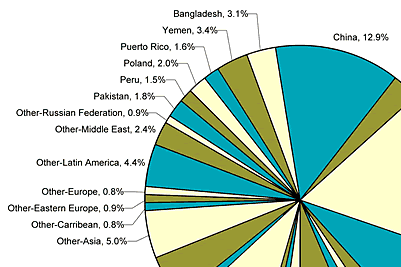
Chart: Student Demographics for |
Dual-language instruction
Beyond these basics, educators favor two models for educating immigrant students—dual-language instruction and a “newcomers” approach.
In two-way bilingual or dual-language programs, immigrant students are combined with English-speaking students, and teachers instruct all of them in two languages: English, and also the language of the newcomers. The instruction might alternate weekly (one week English, one week Spanish, for example) or more often, but neither language dominates. “Each group gets to help the other group learn their language and vice versa. They’re in the same class. They have opportunities to interact, so they’re talking informally and socially as well as about academic subjects, and it works very well,” said Feinberg.
All students benefit in this arrangement, she said—immigrant students get an equal chance to show what they know in subjects such as science, math and social studies, and English students get to learn another language fluently. “You learn it much better than it is possible to learn in a traditional foreign language class, where you go for 40, 50 minutes a day maybe three to five days a week for a year, maybe two years,” Feinberg added.
Nelson Gonsalves, 11, attends the International Charter School in Pawtucket, RI, an elementary dual-language school that offers English-Portuguese and English-Spanish classes. Nelson was born in Portugal and already spoke some English before his family moved to Rhode Island. He says the school has made his transition much easier. “I used to go to a public school and they only used to speak English,” he said. “This school has actually helped me adjust to a different environment and it helped me in reading in Portuguese, writing. Every week we switch back and forth, both languages, and you’re not losing one, your native language, and you’re still learning your English.”
Newcomer schools
Another recognized education model for immigrants is the “newcomer” school. These schools differ greatly with dual-language or traditional schools in that there aren’t any English-speaking students there. All of the students are immigrants from around the world who are immersed in the English language. Beyond that, newcomer schools vary. Some focus on grade-school children and keep them for only a year or so, or once they are proficient in English and can join their peers at traditional schools. Some focus on older children and keep them until they graduate.
Jean Ambroise, 18, has spent two years at Newcomers High School in Long Island City, N.Y. With an enrollment of about 940 in four grades, Newcomers High School is very diverse, consisting of about 30 language groups, although Spanish and Chinese predominate. The schedule is vigorous—students are given nine hours a week of ELL instruction until they pass a language battery test. Once they pass the test, they are placed in two regular English classes, one that focuses on fiction, reading and writing, and another that concentrates on non-fiction and structure. Classes in content areas are trilingual (in Spanish, Chinese and English).
Though Jean, who was born in Haiti, says the school really helped him with his English, he says it has some challenges. For example, he said that it’s sometimes hard to learn English because all of the students are newcomers and thus no one speaks English very well. It’s also hard to make friends for lack of a common language.
Feinberg says this is the primary drawback of newcomers’ schools: “If there’s no opportunity for them to interact with one another, that delays their English language acquisition,” she said.
However, she also said the newcomers approach can be good for older students who don’t have much subject knowledge, either because their education was interrupted in their home country because of earthquakes or wars or because they are from remote areas where schools aren’t plentiful. “For students who would get here and be very far behind their peers in terms of content knowledge, like math and social studies and science, it may be more effective for them to be placed in newcomer centers for a limited period of time to kind of catch up before they go back into the mainstream.”
Moving backwards
Nevertheless, some schools are moving away from recommended practices for educating immigrant students. Comprehensive programs are being replaced with old-fashioned immersion programs, which can compromise a student’s first language, said Coll. “We have a sense that we need to bring kids immediately into learning English, and we don’t care about what happens with their first language. And that is completely against what we know about language and about what needs to be done for kids,” she said.
This change has come about, in part, because of tough economic times, says Feinberg. “I think over time, attitudes toward immigrants have gotten more negative, more hostile, and more hysterical.”
But hostile attitudes will not stop the need for a well-educated populace. And, as U.S. Census figures show, immigrants and minorities are responsible for much of the recent population growth.
“The population growth, in this country, is due mostly to children of color and children of immigrants,” Coll said. “If we don’t learn quickly how to incorporate these populations into good education, good jobs, housing, all the benefits that the United States offers many of us, we are going to go downhill.”
<- BACK 1 | 2