As a founding member of Adobe Youth Voices (AYV), What Kids Can Do (WKCD) not only worked with youth in the United States, but also with youth in six other countries—helping them capture and share their corner of the world. “Show us your lives,” we asked students, when we sent digital cameras to our partner organization in each country. “Help us see the communities you belong to and the issues that stir you.”
These novice photographers eagerly set out to do so, passing cameras among themselves and together discovering how to frame their world through a new lens. Some had never held a camera before, and few kept records of who took which photograph. The extraordinary image bank that resulted must be collectively attributed to a rising generation at a certain moment in places far and wide, seeing its world anew. Singly, each project weaves its own story. Together, they remind us of what we hold in common, across boundaries of geography, culture, class, and race.
Bangalore, New Delhi, and Noida, India
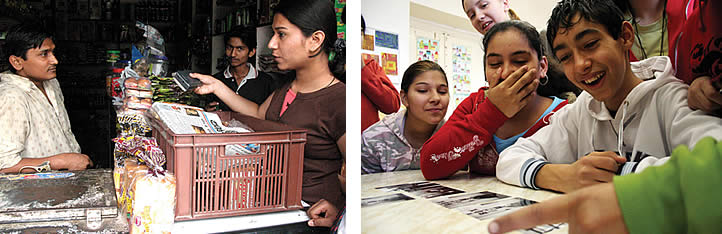
"A Day in the Life of Bangalore": “How do you make the camera snap?” asked Prakash, a student at Government High School in the Cotton Pet neighborhood of Bangalore. “I have never known a camera before.” At his side, his teacher translated his words into English from Kannada, the city’s most common language. Prakash and ten of his classmates, ages eleven to fourteen, took close to 2,000 digital photographs over the next several days, capturing daily life in their neighborhood and in Bangalore’s largest open market and park. A ten-year-old girl washing her family’s laundry on the sidewalk, two blocks from their school. Street venders selling fruit, vegetables, spices and rice. A finely dressed family picnicking in Cubbon Park.
"A Ray of Hope: Child Labor and Rights": Since 1997, the Child Rights Information Centre (CRIC) of Bal Panchayat, a youth-to-youth development program in New Delhi’s slums, has campaigned to support children’s rights and end exploitative child labor in New Delhi and beyond. Seven CRIC youth leaders—all of whom grew up in Bal Panchayat—set out to create a media campaign that put a human face on child labor: children as young as six picking rags, or fetching and carrying home the daily supply of water; older siblings taking care of younger ones while their parents worked; young friendships thriving in the midst of poverty. “Our hearts are full with the stories behind our pictures,” said Harsh Vardin, nineteen.
"India at a Time of Globalization": “Combining different worlds and cultures at the same time, this is today and this is our future,” said fifteen-year-old Ashish. For a year, Ashish and twelve of his classmates at Noida Public Senior Secondary School gathered photographs and interviews that showed the contrasts globalization now produces at every turn across India: between old and new, Eastern and Western, rich and poor, traditional and progressive. The students took more than 1,500 photographs and interviewed over 50 people, from a rickshaw driver to a corporate lawyer. “At first I was afraid to snap a photo in public or to ask someone if I could interview them. It is not our custom and the child is always below the elder,” explained Sapna. “Once we adjusted to this, we could not be stopped.” Their photo essays are presented in the book India in a Time of Globalization: A Photo Essay by Indian Youth. The Noida students also produced a Hindi-English multimedia dictionary.
Click here to see the work of all three groups.

Beijing, China
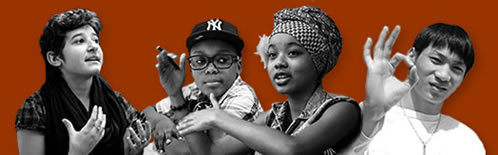
“Hey! We are the six bloggers—Iris, Siqi, Steven, Linda, Kelan, and E-mail—of Adobe Youth Voice’s and What Kids Can Do’s Beijing Youth Voices! We are all high school students in Beijing, with a range of interests, talents, and personalities—like teenagers around the world. For the next six months, we will be posting bi-weekly blogs, giving you a peek into our lives and life in China.”
So began the first of many blog entries, filled with photographs and stories, from the six-member Beijing Youth Voices team. The group met on Saturdays at a centrally located tea-shop, where they reviewed each other’s work and then set out to explore with their cameras a new part of the city. The students posted their blogs in Chinese on baidu.com and in English on wordpress.com. With the 2008 Summer Olympics, the team trekked across Beijing to capture the Olympic spirit far from the famed “Bird’s Nest”—from “Smiling Beijing Welcomes You” banners to sidewalk health stations.
Check our their blogs in English at http://beijingyouthvoices.wordpress.com/.
Watch their audio slideshows for an inside look at the 2008 Beijing Olympics—and more.

Budapest, Hungary
A lifetime ago, tens of thousands of Hungarian students took to the streets of Budapest, sparking a nationwide uprising against that country's regime. Troops moved to crush the rebellion, and some 3,000 were killed. That was 1956. Today, a new generation of Hungarian youth reaches out to one another—and to the very young and old—with a sense of justice and remarkable goodwill. The Foundation for Democratic Youth (DIA) weaves together that community spirit through local volunteer chapters across the country.
Youth in seven DIA chapters, from Hungary’s eastern to western borders, photographed those volunteer activities as part of Adobe Youth Voices. Their pictures counter the image of an Eastern Europe strained by mistrust and ethnic division. Instead, they show the pleasure that comes from community celebrations, breaking bread with strangers, a litter-free park, befriending children whom society has discarded.
Click here to read more and see the work.

Cluj Napoca, Romania
For Olimpia, Ovidiu, Ramona, and Roxana, home is the Roma hillside village of Baciu on the outskirts of Cluj Napoca, with all of its Roma traditions. For Ale, home is split between her birth family and the facility where she lives much of the week with other young people who cannot always live with family. For Titus, home is the city of Timisoara, with its legends and fountains.
These are some of the stories told through photographs, music, and text by seventeen Roma youth across Transylvania, all members of the Resource Center for Roma Communities. “The majority of people have a cliché about the Roma people,” said Mihai, a university student. “They steal, they are bad. People don’t see the good part. A problem of ours, as Roma, is that we don’t show them our tradition, our good parts.” The photos taken by these youth counter that stereotype, winning attention and praise in public exhibitions.
Click here to read more and see the work.

London, England
As immigrants with few chances to travel outside their working-class neighborhoods, the six eleven- and twelve-year-olds on the photography team at Lilian Baylis School toured their city with wide eyes. “We never knew these sights were right here!” said Jamaican-born PJ, as he studied Westminster Abbey, posed with a waxen James Bond, and checked out street venders in busy Clapham Junction. Encountering students at the gate of one of London’s most elite schools, they wondered aloud, “Are they smarter than us, or just richer?” (Yeliz, Ricky, and PJ guessed “smarter,” but Nicole, Monira, and Sabrina disagreed.) Nothing escaped these young photographers. And their comfort with asking strangers if they could snap their picture produced a portrait gallery that includes members of the House of Lords, young lovers, and immigrants like themselves.
Click here to see the four-part "Day in the Life of London, England"

Prague, Czech Republic
With cameras and a passion for photography, students from two vastly different districts in Prague, Czech Republic spent the first half of 2008 exploring each other’s neighborhoods and learning about each other. Ages eleven and twelve, the first group came from Prague’s Zizkov district, home to Ukrainian immigrants and Roma and long known as the bohemian section of Prague. The second group came from Modrany, where huge apartment blocks built during the Soviet regime stand next to centuries-old villas.
Between biweekly workshops, students worked on assignments like taking a self-portrait or capturing a typical situation in their homes and among friends. At the workshops, they discussed their photos and the lives they revealed. The non-governmental entity Multicultural Centre Prague organized and supported their work as part of a Europe-wide “Cultures Around the Block” project.
Click here to read more and see the work.